
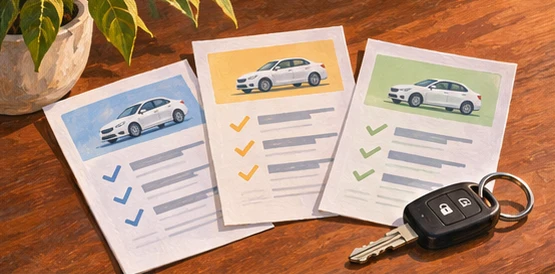
Three car insurance quotes are sitting on your kitchen table. One asks for the smallest down payment. Another advertises the lowest monthly bill. The third costs more, but it is the only one that clearly lists collision coverage. If you pick a winner based on the biggest number on the page, you might choose a policy that leaves you paying for the very loss you wanted covered. Start by making the quotes comparable, then decide what you can afford today and what you could afford after a claim.
Start with one set of facts
Write down the vehicles, drivers, garaging address, estimated annual mileage and date you need coverage to begin. Give the same information to every agent. If you use the car for deliveries, carry passengers through a rideshare app, or let someone in your household drive it regularly, say so upfront. A low price based on a different driver list or use is a price for a different application.
Check the vehicle identification number against your registration, and make sure each quote reflects whether the car is owned, financed or leased. If a lender or leasing company requires certain coverage, check its written requirements before comparing offers. Ask your agent to walk through any assumptions the quote makes about the vehicle. Barua’s California auto insurance page is a starting point for choosing what to compare.
Put liability limits in the first row
Liability limits describe how much the policy may pay for covered claims against you, subject to the policy. Compare bodily injury per person, bodily injury per accident and property damage per accident separately. A quote with lower limits can appear cheaper because it is taking on less of the potential cost. Ask for the same limits on every quote and then request a second set of prices if you want to see how higher limits change the premium.
Imagine a fender bender that turns into a chain reaction at a Long Beach intersection. The number you need to read depends on what happened. Vehicle repairs and injuries draw on different parts of the liability coverage, and the amount available for one injured person can differ from the amount available for the accident as a whole. If you are checking the baseline requirements for your vehicle, start with the California DMV insurance requirements and confirm the policy limits with your agent.
Give your own car a separate row
Ask whether comprehensive and collision are included, which vehicles they apply to and what deductibles are listed. Compare them separately. You might choose a different deductible for each, depending on what you can comfortably pay and what the insurer offers. If a quote says “full coverage,” ask the agent to translate that phrase into a written list of coverages, limits and deductibles you can check.
Then think about an ordinary Tuesday. If your car is in the shop for a week after a covered loss, could you get to work without it? If rental reimbursement matters, check the daily and total limits and ask when the coverage would apply. If the quote lists roadside assistance, ask which services it includes and whether you already have similar help through a membership or another service. Write these items on separate lines so they do not disappear into the monthly price.
Compare what you actually pay over the term
Make four columns for each offer: amount due to start, number of later payments, amount of each later payment, and any fees that are separate from those amounts. Ask the agent to confirm the policy term and which charges are already included in the total. If one quote is for six months and another is for twelve, ask for comparable terms or clearly label the periods. A quote covers a particular term, and a later renewal price may change.
Imagine Quote A asks for less to start but requires higher installments. Quote B asks for more to start but offers lower installments for the same term. Which costs less overall? Multiply each installment amount by the number of installments, add the amount due at signing and account for any separate charges. Then check both the total and the dates payments are due. A payment schedule works only if you can keep up with it after the first bill.
Check the driver, filing and timing details
Read the driver list again before you bind coverage. If a driver is excluded, ask the agent to show you the written exclusion and explain how it applies. If you need proof of financial responsibility filed with the DMV, tell the agent early and confirm the filing type and timing separately from the policy start date. Barua’s SR-22 filing page explains how to start that conversation. If you do not own a car, see non-owner auto options and describe the cars you use and how often you use them.
Ask for the exact date and time the new policy takes effect and what payment or paperwork is still needed. If you are replacing an existing policy, coordinate the two dates before requesting cancellation. Keep the confirmation and proof of insurance where you can retrieve them. If there is a mismatch between the effective date and the day you plan to pick up or drive the vehicle, call the agent before relying on the quote.
Check what changed since your last renewal
Before you call, take two minutes to write down what is different from last year. Did you move, add a car, change jobs, start commuting fewer miles, or let a family member take a vehicle to school? Ask the agent which changes affect the application and which details the insurer needs to confirm. If you have more than one car, look at the coverages on each one individually. A policy summary can make everything appear uniform even when two vehicles have different deductibles or options. Keep the revised comparison so you can explain what you chose when renewal time comes around.
Build a comparison you can read in one minute
Confirm each quote uses the same drivers, vehicle use, mileage and start date.
Match the three liability limits before comparing premiums.
Check comprehensive, collision and their deductibles vehicle by vehicle.
List optional coverages and note any exclusions that matter to you.
Compare the total for the same term, including any applicable fees.
Confirm what must happen before the policy can take effect.
If one quote still costs more after you match those items, ask the agent to show you where the difference comes from. It might be an installment charge, an optional endorsement, a different rating assumption or simply a different insurer’s price. Ask for a revised comparison if you discover a mismatch. The goal is to understand the trade you are making before you sign.
Long Beach drivers can start with Barua’s local car insurance page. Wherever you live in California, request a Barua Insurance quote with the limits, deductibles and start date you want compared. If you have a current policy, keep the declarations page handy so the agent can see what you carry today. You can also contact the Long Beach office if you need help reading a quote before deciding.